
Case study · Official Progress Service Delivery Partner
500 Crystal Reports, one 40-hour pilot: de-risking a move to Telerik Reporting
- Industry
- Aerospace supply chain, USA
- Migration
- Crystal Reports → Telerik Reporting
- Engagement
- Consulting sprint, 40 hours over about 11 weeks
- Data
- Microsoft SQL Server (stored procedures and SQL queries)
- Delivery
- Fully remote, inside the client's secured VPN and virtual machine
Key results
- 10 reports migrated, from simple to complex
- 65 more reports assessed, with effort estimates and a roadmap
- ~500 reports screened: a view of the whole portfolio
- Matching output from old and new reports on the same data
- No report got slower; some ran faster
- Sponsor deadline met with visible progress
Client details are withheld for confidentiality.
The client
A long-established US company that supplies certified processing and testing services to the aerospace sector, where accuracy and traceability matter.
Day-to-day operations ran on roughly 500 Crystal Reports, many of them written years earlier. Users opened them as PDFs from an internal web platform. The company had decided to replace Crystal Reports with Telerik Reporting and needed to know how to get there safely.
The challenge
Migrating a few reports is routine. Migrating 500 is a programme, and the client could not start one without answers to three questions: Will it work? What will it cost? How do we avoid breaking things?
- Scale without a method. About 500 reports was far too many to migrate one by one with no proven approach and no credible estimate.
- A sponsor deadline. The project team had to show its sponsor real progress within a short time.
- Reports nobody could explain. Some reports were so old that no one at the company could say how they should behave in certain cases.
- No one-to-one mapping. Most report elements carried across directly, but subreports and some Crystal formulas had no direct equivalent in Telerik Reporting.
- A locked-down environment. Work was only possible through a VPN and a shared virtual machine, so the usual tooling was off the table.
- Output had to match. Users relied on the PDF exports, so the migrated reports had to produce the same results.
Our approach: pilot first, then plan
1. Pick a representative sample. We chose 10 reports that covered the full range of the estate: simple, mid-complexity and complex. If the method worked on these, it would work on the rest.
2. Analyse before rebuilding. We reviewed the Crystal report definitions to list every element, formula, subreport, grouping and data source, and flagged the risky parts early. Working sessions with the client’s technical team mapped the SQL Server data model, stored procedures and queries behind each report.
3. Recover lost business logic. Where nobody could explain how a legacy report should behave, our consultant worked it out from the report definition, the underlying data and the existing output.
4. Prove parity with evidence. Every original and migrated report ran against the same sample data and parameters, and the exported results were compared. The client got objective proof that the new reports were correct, not just an assurance.
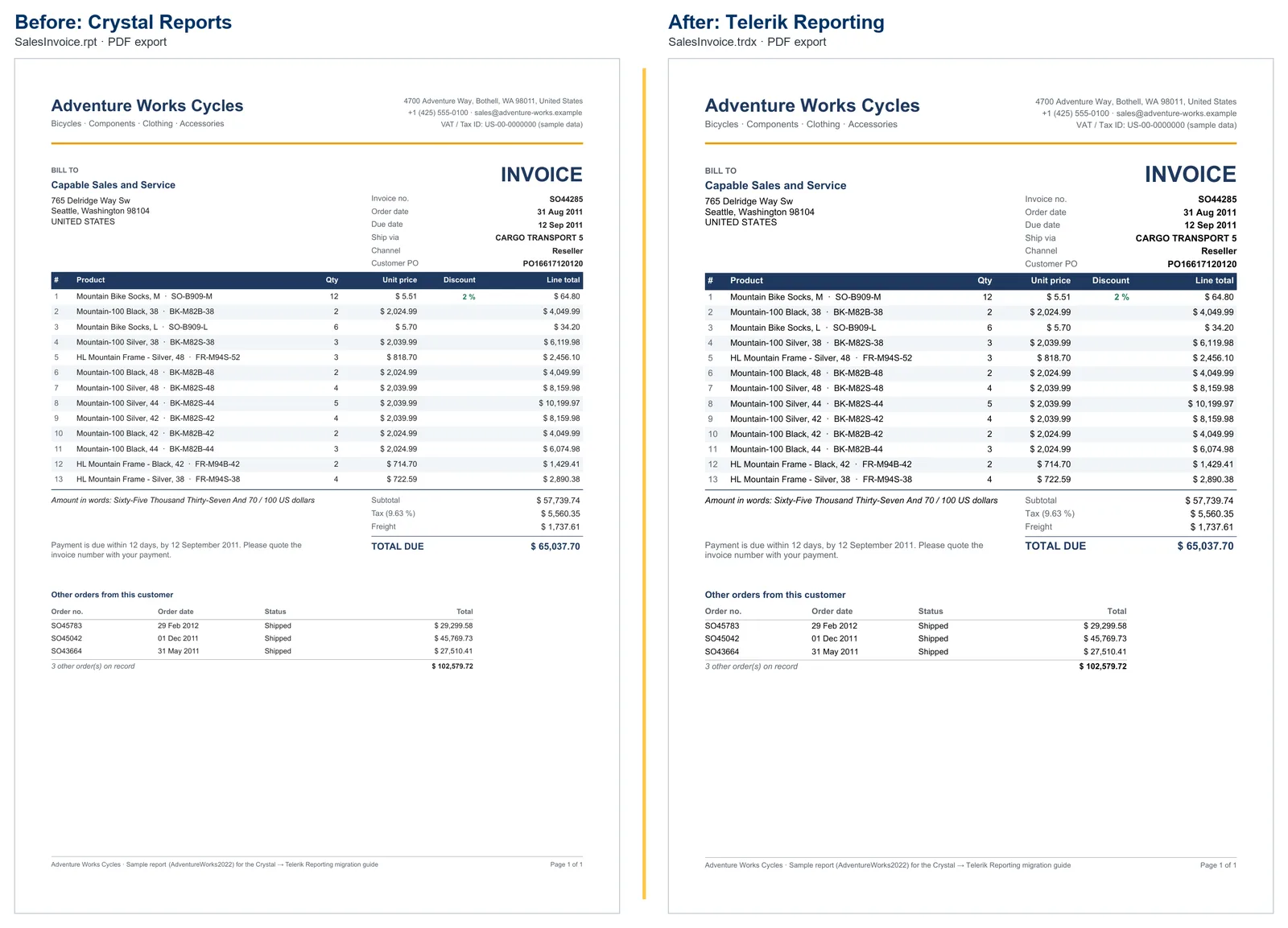
5. Keep the team informed. Weekly syncs covered questions, progress, demos of migrated reports and feedback.
What we delivered
A working pilot. Ten reports rebuilt as Telerik Reporting definitions. Subreports got dedicated handling, and Crystal formulas without a direct equivalent were rewritten with standard Telerik Reporting expressions, so there is no custom code to maintain for years.
A migration playbook. The critical report elements and the recommended way to migrate each one, so the client’s own team could work through the remaining reports consistently.
A portfolio assessment and roadmap. A high-level screening of the ~400–500-report estate, including reports the client had already migrated, then a formal assessment of 65 further reports: complexity, effort estimates, risky components, the recommended implementation approach and a phased roadmap.
The results
| Area | Before | After |
|---|---|---|
| Migration approach | No proven method for ~500 reports | Pilot-tested method and a written playbook |
| Effort visibility | Unknown cost and timeline | 65 reports estimated, with a roadmap |
| Legacy logic | Undocumented, no one to ask | Recovered and rebuilt |
| Report accuracy | Unverified | Matching output on the same data |
| Performance | Crystal Reports baseline | Same or faster |
| Maintainability | Crystal formulas | Standard Telerik Reporting features only |
All of this fit in a 40-hour budget: the pilot, the playbook and the portfolio assessment. The client met its sponsor checkpoint with concrete, demonstrable progress and a costed plan for the rest of the migration.
Lessons for any Crystal Reports migration
- Pilot before you plan. A small sample that covers the full complexity range tells you more than any estimate made on paper.
- Prove parity, don’t assume it. Run old and new reports on the same data and compare the output.
- Expect lost knowledge. Older reports often outlive the people who wrote them. Budget time to recover their logic.
- Avoid custom code where you can. Built-in Telerik Reporting features keep migrated reports easier to maintain.
- Write the playbook early. Migration guidelines let your own team scale the work without an expert on every report.
